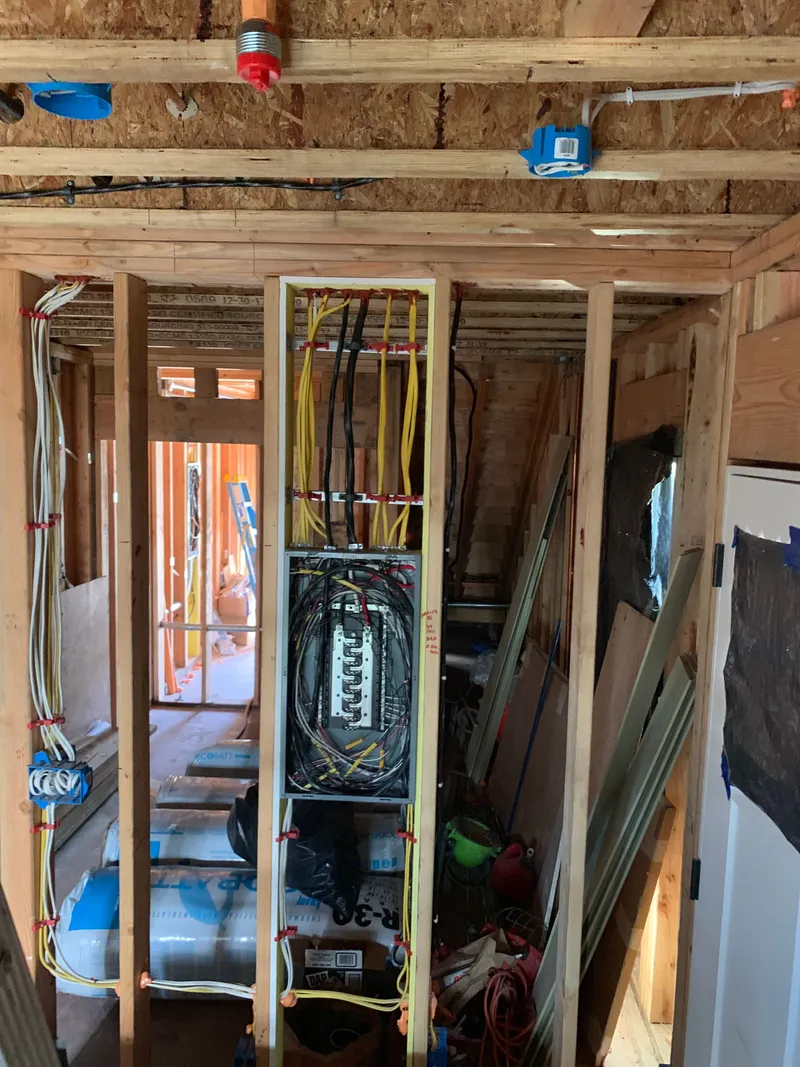
Who this guide is for
If you live in Oakland, Berkeley, Alameda, or one of the surrounding East Bay cities and you're planning electrical work — a panel upgrade, an EV charger, recessed lighting, a kitchen remodel that needs new circuits, or a full rewire — this guide walks through what that actually costs, how long it takes, what goes wrong, and how to tell whether the electrician you're about to hire knows what they're doing.
Everything below comes from the licensed team who handles our work. Real pricing ranges from real East Bay jobs, not numbers pulled from a nationwide home-improvement blog. Where a specific tier is called out, it reflects what we actually charge — but every home is different, so your final number comes from a walkthrough, not a quote sight-unseen.
What residential electrical work actually costs
Small site-specific details (distance from the PG&E drop, attic access, finish materials) can swing a job 30–50%. Here are the ranges we see:
Panel upgrade (100A → 200A)
The variable is almost always the distance from the PG&E service drop to where the new panel lands.
- Within 10 ft of the PG&E drop$5,000–$6,000
- 10–30 ft, or multiple pipe runs$7,000–$8,000
- Beyond 30 ft (with PG&E approval)$10,000–$12,000
If we can reuse the existing weatherhead and stay in the same location, we're on the low end.
Level 2 EV charger (60A fast charger)
The jump in price between tiers is mostly wire cost and conduit labor.
- 0–10 ft from panel$1,500–$2,000
- 10–30 ft$2,000–$2,500
- Beyond 30 ft Run complexity drives the numberOnsite inspection
- 40A charger Across all tiers above~15% less
If your garage is on the far side of the house, we're sometimes better off adding a subpanel than running a long dedicated circuit.
Recessed lighting
- Per can installed$250
- Typical room (4 cans + dimmer)~$1,200
- No attic access Channels in walls/ceiling or exterior conduitSignificantly more
When there's no attic above the room, the labor roughly doubles because every fixture location needs a drywall cut-and-patch sequence.
Whole-house rewire
1,500 sqft is the median Oakland bungalow — the number we see most often.
- 1,500 sqft, 3-bed / 2-bath Includes new subpanel; main panel priced separately$22,000
Larger homes scale up roughly linearly. Knob-and-tube, aluminum wiring, or lath-and-plaster (common in 1920s East Bay stock) pushes to the high end.
Minimum service call
- One-hour fix-and-go Outlet swap, light fixture, single 240V add$300 minimum
- Troubleshooting (first hour)$250
- Troubleshooting (hour 2+)$180/hr
We don't quote troubleshooting over the phone — dead circuits can be a $40 breaker or a $4,000 damaged conductor buried in a wall.
How long each job actually takes
Timelines are the thing most homeowners get wrong. There's the work timeline (how long we're actually swinging tools) and the calendar timeline (how long from signed contract to power restored). They're rarely the same.
Panel upgrade (100A → 200A)
1–2 days of actual work. Calendar timeline is weeks to months because of PG&E.
- 01 City permit City-dependent
Each city runs its own queue. We file it right after the walkthrough and track it to issuance.
- 02 PG&E scheduling Weeks to months
Meter disconnect and reconnect window. The long pole on every panel upgrade.
- 03 PG&E engineering (if drop extends) +weeks to months
Only triggered if the service drop has to be physically relocated or extended.
- 04 Install day 1–2 days
We minimize power-out time to a half-day window. Heat, fridge, one live outlet kept up where possible.
Level 2 EV charger install
1 day typical. 2 days if the run is long or conduit is complex.
- 01 Permit City-dependent
Each city runs its own queue. We file it right after the walkthrough and track it to issuance.
- 02 Install day 1 day
Wire pull, conduit, breaker, mount, test. Most jobs finish same-day.
- 03 Inspection Scheduled separately
City inspector signs off on the rough and final. Charger is usable after final.
Whole-house rewire
2–3 weeks on a 1,500 sqft, 3-bed / 2-bath home.
- 01 Permit + walkthrough City-dependent
Each city runs its own queue. We file it right after the walkthrough and track it to issuance.
- 02 Rewire 2–3 weeks
Faster if the family can leave. Furniture, kids, and daily routines stretch the timeline.
- 03 Patch & paint 1–2 weeks
Handled by a separate trade after we're done. Budget this upfront.
Hidden costs nobody warns you about
Every rewire and panel job has a couple of places where the price can jump unexpectedly. We flag these at the walkthrough so they're not surprises, but here's what to watch for:
What we won't do, even for the money
Some work we turn down. Not because the money isn't good, but because the risk profile or quality requirements don't match how we run the business:
- Industrial electrical work We're residential and light-commercial. Heavy three-phase industrial systems need a different shop.
- Fire-hazard panels (Federal Pacific Stab-Lok, Zinsco) with an add-a-breaker request If the panel is a documented fire risk and the homeowner wants us to just add circuits to it, we decline. The panel is the problem.
- Discount off-brand breakers We install Siemens and Square D almost exclusively. The price difference is a few dollars; the 20-year failure rate difference is significant.
Real Oakland, Berkeley, and San Pablo jobs
Because market ranges can feel abstract, here are three jobs we've handled recently that show what the real numbers look like:
Whole-house rewire
Original wiring was a mix of knob-and-tube and early Romex. New subpanel, all new circuits, smoke/CO detector hardwiring. The attic framing was open enough to run most of the home cleanly.
100A → 200A panel upgrade, ~30 ft service run
The new panel location was ~30 ft from the PG&E drop. Normally that triggers PG&E engineering review plus a charge to extend cables — months and thousands added. We proposed running the 30 ft feed through the existing weatherhead instead. PG&E's side didn't change, city and PG&E both approved. Saved the homeowner the engineering fee and the delay.
Whole-house rewire
Similar scope to the Oakland job. Standard lath-and-plaster construction, moderate attic access. The $1,000 delta vs Oakland came down to how clean the attic access was.
How long permits take, city by city
Permit speed is wildly different depending on which city your house sits in. This isn't opinion — it's what we see month over month on real jobs:
Permits in the East Bay
- Oakland Planning & Building at 250 Frank Ogawa Plaza. We file it and track it.
- Alameda Building & Safety Division. We file it and track it.
- Berkeley Building & Safety Division reviews thoroughly. We factor it into the schedule.
- Richmond / San Pablo / El Cerrito / Pinole Separate West Contra Costa building departments. We file and track each one.
The #1 mistake East Bay homeowners make
Picking the cheapest bid from the least-experienced electrician is, hands down, the most expensive decision a homeowner can make. It's not just about the electrical work itself — it's that an inexperienced electrician often doesn't flag the finish-quality conversation upfront.
They'll quote you a panel + recessed-lights job, you'll find the sconce fixtures you love at the lighting store, and then discover the bid didn't include compatible dimmers. Or the generic recessed cans they quoted flicker on a dimmer. Or the bargain-brand breaker they installed two years ago now needs replacement.
A good electrician asks what finishes you want, walks you through the quality tiers, and shows you what matters and what doesn't. You can buy cheap LED cans or you can buy Halo/Juno fixtures — both work, but they don't dim the same, and you need to know that before the bid gets written.
Three questions to ask any electrician before hiring them
If you want to separate a real licensed electrician from a handyman or someone working outside their depth, these three questions filter 90% of the bad outcomes:
- "Can you explain how a 3-way switch works?" A 3-way switch lets two switches control the same light (top of stairs, bottom of stairs). Any competent electrician answers in 20 seconds. Vague or pivoting answers are the filter.
- "How many inspections does this job need?" For most residential electrical work, the answer is two: a rough (after wires are pulled but before drywall closes up) and a final (after everything is energized). Anyone mumbling "probably one" is a red flag.
- "Are you licensed? What's your license number?" California requires a C-10 license for electrical contracting. Our work is performed by our licensed electrical partner, CSLB #1062166 — verifiable on the CSLB website. Cash-only quotes without a license number are a walk-away.
When you're ready for a real walkthrough
Electrical work is one of the highest-stakes trades in home construction. A good job disappears into your walls and works reliably for 30 years. Reach out and we'll look at what you have, what you want, and give you a straight answer on what it costs and how long it takes.
Related reading
- When to Upgrade Your Electrical Panel: 5 Warning Signs — signs your 100A panel is overdue.
- EV Charger Installation at Home: What Oakland Homeowners Need to Know — the electrical side of adding a Level 2 charger.
- Recessed Lighting Layout: How Many Cans Per Room? — spacing and count by room.
- Do I Need a Permit for Electrical Work in Oakland? — what triggers a permit and what doesn't.