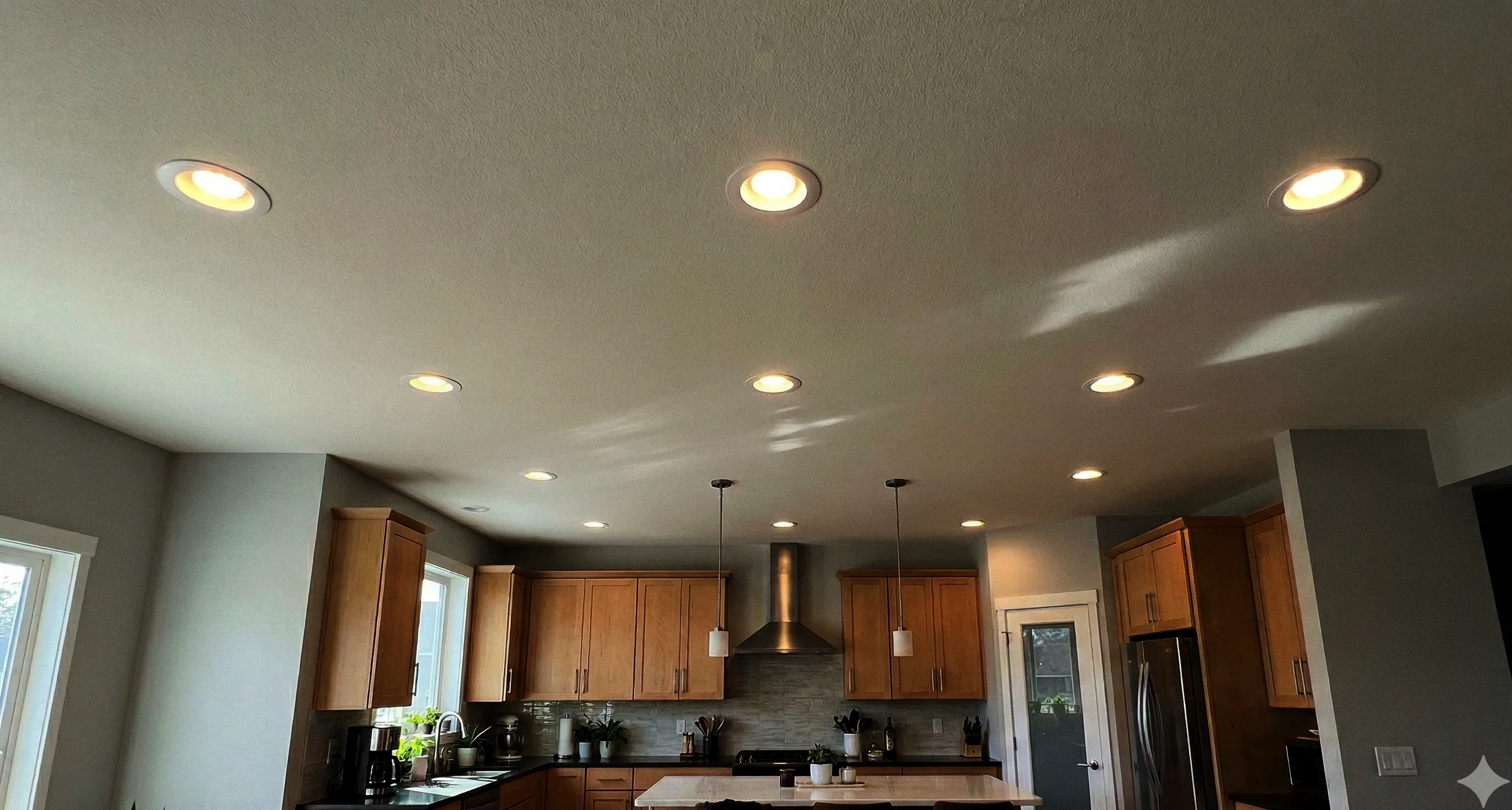
The most common question we get about recessed lighting
"How many lights do I need?" It's the first thing every homeowner asks when they're planning recessed lighting. Too few and the room feels dim and patchy. Too many and you've got a ceiling that looks like a runway. The answer depends on three things: room size, ceiling height, and what you're using the room for.
Here's a practical guide based on what we install in homes across Oakland, Berkeley, and the East Bay every week.
The basic spacing rule
For standard 8-foot ceilings, the general rule is: divide your ceiling height by 2 to get the spacing in feet. So 8-foot ceilings = lights spaced about 4 feet apart. For 9-foot ceilings, 4.5 feet apart. For 10-foot ceilings, 5 feet apart.
Keep lights 2-3 feet away from walls to avoid harsh shadows. If you're lighting artwork, countertops, or bookshelves, you can bring them closer to the wall — about 18-24 inches — for a wall-wash effect.
This rule gets you in the right ballpark. From there, adjust based on the room.
Room-by-room breakdown
Kitchen
Kitchens need the most light. You're working with knives, reading recipes, and checking whether the chicken is actually done. Plan for one 6-inch recessed light per 25-30 square feet of kitchen space, plus dedicated lights over the sink, stove, and island.
Kitchen layouts we see most often
- 10×10 kitchen (100 sqft) 4 recessed cans + under-cabinet lighting.
- 12×14 kitchen (168 sqft) 6 cans + task lighting over island and sink.
- Open kitchen (200+ sqft) 8–10 cans, zoned on separate switches so you can dim cooking vs entertaining zones independently.
Living room
Living rooms are more about ambiance than task lighting. You don't need surgical brightness — you need even, comfortable light with the ability to dim. Plan for one light per 30-35 square feet.
Living room layouts
- 12×14 living room (168 sqft) 5–6 cans.
- 15×20 living room (300 sqft) 8–10 cans.
- Open-concept living/dining (400+ sqft) 12–14 cans, zoned separately so the dining and living sides can dim independently.
Consider placing a few cans closer to walls to wash light down bookcases or accent walls. This adds depth and makes the room feel larger.
Bedroom
Bedrooms need less light than you think. Most people over-light bedrooms. Plan for one light per 35-40 square feet. A 12x12 bedroom (144 sqft) only needs 4 cans. Always put them on a dimmer — nobody wants to wake up to 100% brightness.
Avoid placing a recessed light directly above where your head hits the pillow. It's blinding when you're lying in bed. Offset them toward the foot of the bed and the closet area instead.
Bathroom
Bathrooms are small but need good light — especially around the vanity. For a standard 5×8 bathroom, 2-3 recessed cans plus vanity lighting is perfect. For a master bath (8×10 or larger), go with 4 cans — one over the shower, one over the tub, two for general lighting.
Hallways
Hallways are simple: one 4-inch can every 5-6 feet down the center. A 15-foot hallway needs 3 lights. A 25-foot hallway needs 4-5. Use 4-inch cans instead of 6-inch — they're better proportioned for narrow spaces.
4-inch vs. 6-inch cans
The two most common sizes for residential are 4-inch and 6-inch.
- 6-inch (default choice) Standard for kitchens, living rooms, bedrooms, and open spaces. Wider beam, more light output.
- 4-inch (accent and tight spaces) Better for hallways, bathrooms, accent lighting, and anywhere you want a tighter, more focused beam. Looks cleaner in small spaces.
In practice, most homes end up with 6-inch throughout the main areas and 4-inch in hallways and accent spots. Mixing sizes in the same room looks odd — pick one and stick with it.
LED vs. old-school cans
If your home has old halogen or incandescent recessed cans, switching to LED is one of the easiest upgrades you can make. Modern LED retrofit kits snap right into existing housings — no rewiring needed.
What you get with an LED retrofit
- 80% less energy A 12W LED replaces a 65W halogen.
- 25,000+ hour lifespan That's 10+ years of normal use.
- Less heat in your ceiling Old halogens dump heat into the framing. LEDs don't.
- Better color options Warm (2700K) for living spaces, neutral (3000–3500K) for kitchens and bathrooms.
What it actually costs
Recessed lighting pricing is straightforward when there's attic access above the room. When there isn't, the labor climbs significantly because every fixture location needs a drywall cut-and-patch.
Recessed lighting install
Typical East Bay homes with standard 8-ft ceilings and attic access above the room.
- Per can installed$250
- Typical room (4 cans + dimmer) Kitchen, living room, bedroom — most common scope~$1,200
- No attic access Channels in walls/ceiling or exterior conduitSignificantly more
Patching and painting after drywall cuts are a separate trade — we cut what we need to cut, but drywall finish is handled by your painter.
Do I need new wiring for recessed lights?
If you're adding recessed lighting where none exists, yes — new wiring is required. Each group of recessed lights runs on a dedicated circuit from your panel. The installation involves cutting holes in the ceiling, running Romex between fixture locations, and connecting everything to a new switch (ideally a dimmer).
If you're replacing existing recessed cans with LED retrofits, no new wiring is needed. The retrofit kit uses the existing housing and wiring.
Either way, this is electrical work that requires a permit in Oakland and most East Bay cities. We handle the permit, installation, and inspection.
Want the right layout for your room?
We'll walk through the space with you, sketch the layout, factor in attic access and finish quality, and give you a straight quote — no pressure.
Related reading
- Residential Electrical Services in Oakland: The 2026 Homeowner Guide — the full cost and timeline breakdown across every service.
- Do I Need a Permit for Electrical Work in Oakland? — recessed lighting requires a permit. Here's the process.
- When to Upgrade Your Electrical Panel: 5 Warning Signs — adding a lot of new circuits? Your panel may be the limit.